Musiktheater in Revier

To the north of the town center, the pedestrian zone leads directly to the Gelsenkirchen Stadttheater. The "Musiktheater im Revier" is the single remaining opera stage in the northern Ruhr District. The Great Hall, and the associated Small Hall, were designed in 1954 by a team under the aegis of Werner Ruhnau. The building belongs to one of the most important creations of post-war architecture in West Germany and shows impressively that the young Federal Republic was again associated with international developments in architecture after the rigid self-isolation of the Third Reich. For bombed-out Gelsenkirchen, it must have appeared as the promise of a better future. Additionally, it was a forward-thinking and bold decision to commission unconventional artists for the design, artists who at that time - at best - were familiar only to a small circle of experts. With some right, Yves Klein could maintain in 1958, that they had "resolved in Gelsenkirchen on the erection of a cultural building at the peak of progress and the avant garde".
Schalke 04
The beginnings of FC Schalke 04 go back to 1904, to a loose association of young miners (possessing at the time no recognized status as a society) indulging enthusiastically as a hobby in the Hauergasse with a ball patched several-times. The 'wild' street team was only admitted into the West Deutschen Spielverband in 1915, when many established clubs were unable to deploy a complete team anymore because of the world war.
Lovable anecdotes circulated from the years of Schalke's rapid rise: Before important games Ernst Kuzorra was allowed to sleep underground, while his 'kumpels' hewed his coal for him. Between 1934 and 1942 Schalke experienced unprecedented success and became German champions six times. In 1958, Schalke 04 became champions again - the last time, so far.
Although the team now play in the Arena Aufschalke (Veltins Arena) opened in 2001 between Beckhausen and Erle, (and before that played in the nearby Parkstadion, since 1973) their old Glückauf-Kampfbahn in Schalke-Nord, opened in 1928, still remains for the most part and now stands under protected status. The entrance area on the Kurt-Schumacher-Straße is now named Ernst-Kuzorra-Platz, named after their captain for 25 years.
Ernst Kuzorra's "possibly most important goal of his career" (the one that won the championship for 1933/34 - FC Schalke 04 vs. 1. FC Nürnberg) :
Grillo Memorial
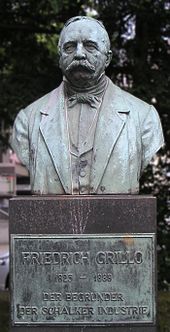
The most significant industrialist connected with Schalke was Friedrich Grillo (1825-88), to whom the "grateful community" raised a splendid memorial in 1898. From a fountain basin rises a granite obelisk on whose main edge a Grillo bust was affixed, flanked by the sculptures of a miner and a blacksmith.
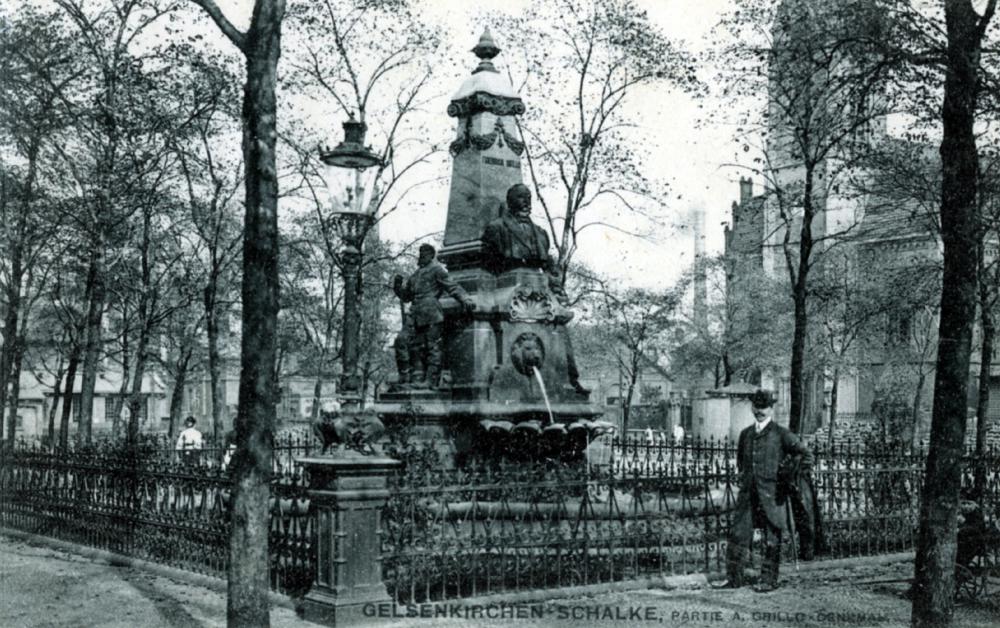
The Schalker Markt, formerly the heart of Schalke, has been spanned since 1964 by a protruding ramp of a road bridge and has since then deteriorated to a bleak storage area for lorries. Even the present-day Grillo-Memorial is only a weak reflection of its former self : miner and blacksmith were melted down for war purposes in 1940 and arose no more. From the battered Grillo-bust, the sculptor Hans Rebbach was able to make a copy in 1954, which since 1965 has stood on a plain plinth opposite St Josef Church.