Mathematical Glossary
Angular Momentum

Configuration Space
Not necessarily connected with 'normal' three-dimensional space.Conic
The general polar form (apart from a circle) is

See Conics
This can be used to derive Lagrange's Equation.
see
Lagrange Equation
same as Conservation of Energy. The quantity which is preserved is the Hamiltonian.
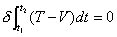
For such a system, the motion is such that the action, i.e.
has a stationary value. Or, in other words, the variation of I is zero, i.e.
When the constraints are
holonomic, Hamilton's principle is a necessary and sufficient condition for Lagrange's Equations.
This allows us to use Hamilton's Principle as a basic postulate (for the conditions stated in the first paragraph), rather than using Newton's Laws of Motion.
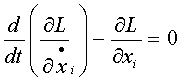
then the
Euler-Lagrange Equations
become Lagrange's Equation
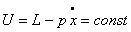
If the Lagrangian is not a function of x
If the Lagrangian is independent of t
where
Since
If there is no force field
which is Newton's First law of Motion
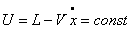
A suitable way to construct a Lagrangian for a conserved system is
If there is no force field
If the potential is
then the orbit is an ellipse
Conjugate Momentum
In general, the conjugate momentum is not the same as 'normal momentum', but if the Lagrangian L is
not dependent on the generalized coordinates q, it is a constant.
Coordinates
See
Generalized Coordinates
D'Alembert's Principle
Ellipse
From the
general polar form, the equation for an ellipse is

Euler-Lagrange Equation

Generalized Coordinates
Hamiltonian

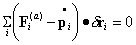
Hamilton's Principle
Describes the motion of mechanical systems in which
all forces (except for forces of constraint) are derivable
from a generalizable scalar potential


Holonomic Constraint
Lagrange Equation
When the action is given by





Lagrangian
We can set up a Lagrangian for holonomic systems with applied forces derivable from an ordinary or
general potential, and workless constraints.
Orbits in a Central Field
Orbits of particles in central fields show three features

Torque
